Key Evidence Needed in Premises Liability Cases
This article details the specific types of evidence that are most important for proving a premises liability case in Arizona, including how timely and thorough documentation can strengthen your claim and what legal counsel can contribute to the process. It also provides background on The Husband & Wife Law Team, a law firm with significant experience in premises liability matters.
When pursuing a claim for injuries sustained on someone else’s property, the outcome often hinges on the quality and completeness of your evidence. Because the burden of proof lies with you as the injured party, gathering and preserving documentation immediately can make the difference between a successful claim and a denied one.
Consulting an experienced premises liability attorney early helps ensure that no crucial evidence is missed or lost, setting you on a stronger path from the start. The Husband & Wife Law Team is a personal injury law firm in Arizona. Mark and Alexis Breyer, known as The Husband & Wife Law Team, met in law school, married, and have been practicing personal injury law in Arizona since 1996. They have eight children. The firm states that they have achieved a high rate of success for their clients, with a reported 98% success rate, though this figure is based on the firm’s own claims.
Core elements every case must establish
To succeed in a premises liability case, several key facts must be supported by evidence. First, you need to demonstrate that a hazardous condition existed on the property, something unsafe that was not adequately addressed or warned about. Next, it must be clear who was responsible for the property at the time of your accident, whether it was a business, private owner, or another entity.
An essential element is notice: evidence should show either that the responsible party knew about the dangerous condition (actual notice) or reasonably should have known through regular inspection (constructive notice). Finally, you must draw a direct line from the hazard to your injuries, documenting not only the incident but also the damages that resulted.
Capturing the scene and documenting hazards
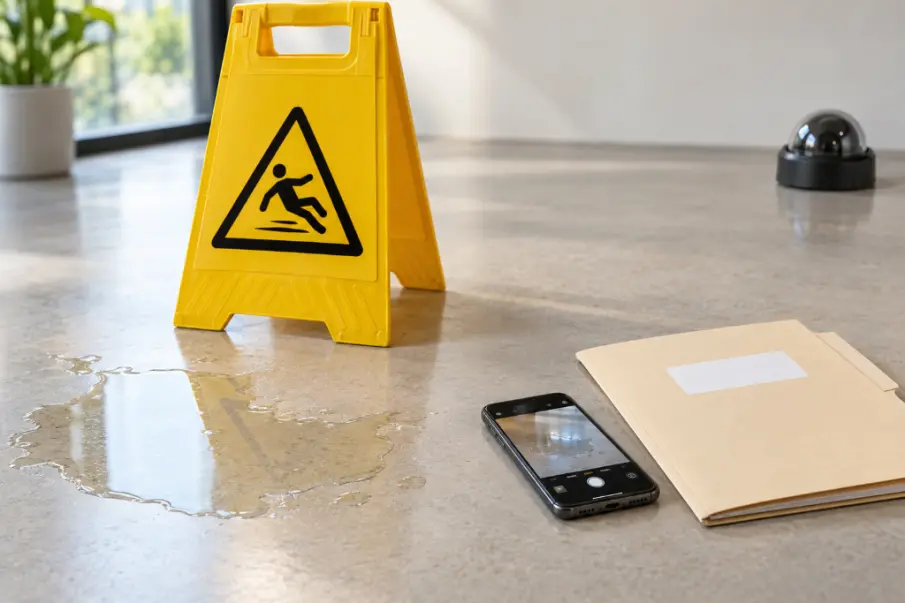
Photographs and video are among the most persuasive forms of evidence you can obtain immediately after an incident. Images should capture the hazard itself, surrounding conditions such as poor lighting, weather at the time, any warning signs (or their absence), and the wider area to provide context.
Including close-ups, wide shots, and angles that display visibility issues, like the depth of a hole or the height of a step, can be particularly valuable. If conditions change over time, repeat documentation may be needed to show what has been fixed or altered.
Records and paperwork related to the property
Written records help build a timeline and identify whether the hazard was longstanding or sudden. Key documents include incident reports filed with property management or security, which you may be able to request. Maintenance logs, cleaning schedules, inspection reports, and repair records can reveal whether the property owner failed to conduct reasonable checks or address known risks. Work orders and vendor records may further document what was done (or neglected) in the lead-up to your injury.
Witnesses and staff as sources of information
Promptly identifying potential witnesses is critical, as memories fade and contact details may be lost. Useful witness statements are those given soon after the incident, with specific, detailed descriptions and no apparent bias toward either party. Employees or security staff on duty may have essential information about past complaints or the actions taken around the time of your injury. Any written notes, emails, or admissions made by personnel could supplement your account and add credibility.
Medical records and documenting your injury
Connecting your injuries to the incident forms the foundation of your damages claim. Medical records should clearly document the timing and nature of your injuries in a manner that aligns with your version of events. A consistent timeline of treatment and follow-up visits help support this link. Supplementing official records with photos of visible injuries and a journal describing symptoms, pain, and limitations can round out the documentation, especially as you recover.
Digital and third-party evidence sources
With security cameras widespread in many locations, surveillance footage often provides objective evidence of how an incident unfolded. However, video systems may automatically overwrite footage within a short period, so it is important to act quickly to request preservation. In some cases, 911 call audio or dispatch reports can memorialize details of the emergency response. Prior complaints about similar hazards, public records, and online reviews can provide supporting context, but their reliability may vary and should be verified for consistency.
Common problems in collecting evidence
Some of the most significant pitfalls are missing a short window to preserve surveillance video, incomplete or inconsistent written accounts, and making statements (including on social media) that could be interpreted in a way that hurts your claim. Repairs made to the scene before anything is documented often make it far more difficult to prove the original hazard, which underlines the need for immediate action after an injury.
The importance of systematic and ongoing documentation
The most persuasive premises liability claims tend to rely on a mix of physical evidence, credible reports, and organized medical records. Keeping everything in order, and consistently updating your documentation as your case progresses, can help keep your claim robust. If you are unsure where to start or need to ensure nothing is overlooked, seeking help from experienced legal counsel can provide support as you navigate the process.